For builders
Find out what actually stopped them.
Scout puts your working product in front of people a trusted community member believes it genuinely fits—then hands you what they said blocked them, what helped, and whether they would come back. What happened, labeled by how it was verified.
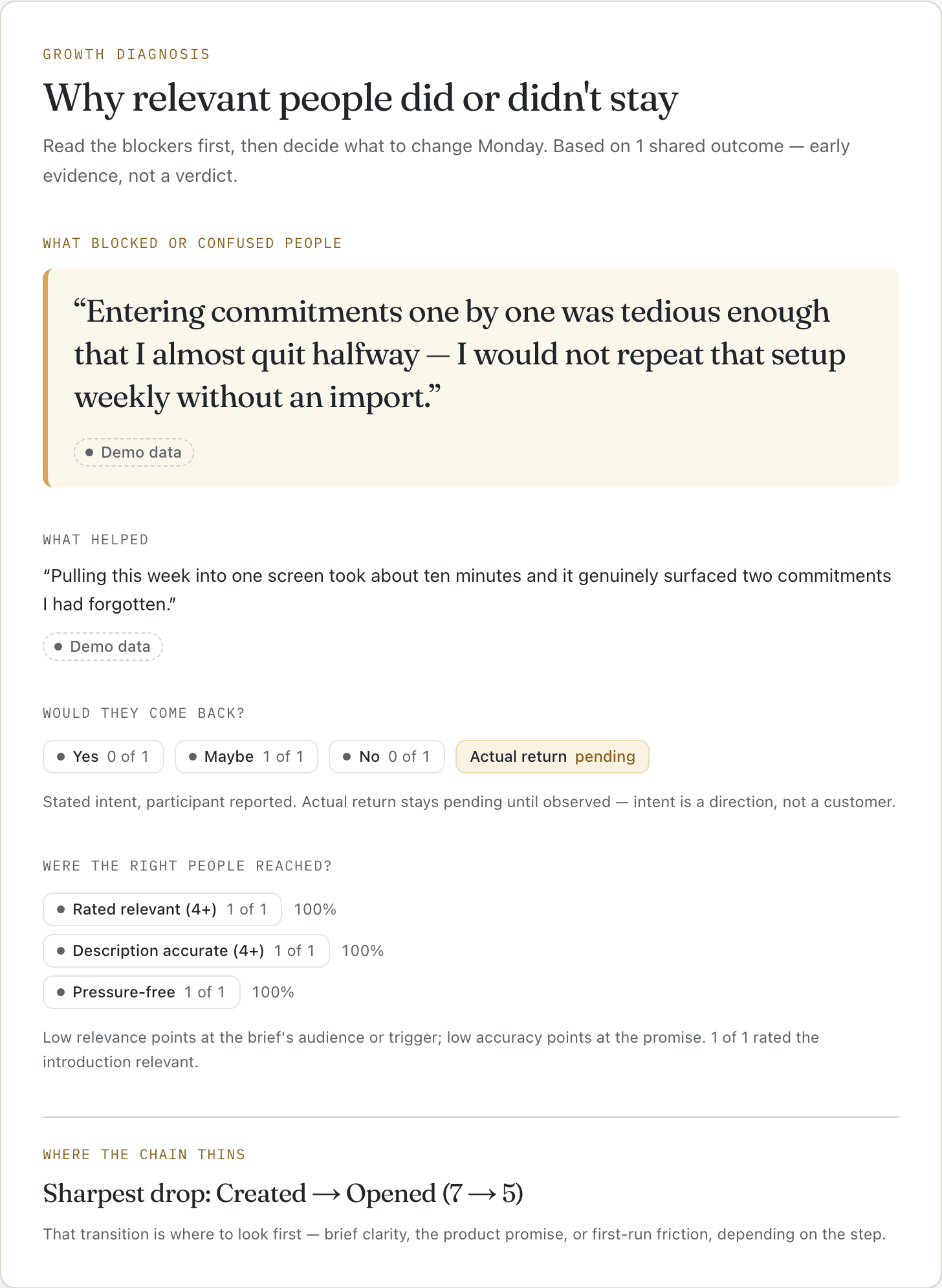
The real product. Seeded example campaign, visibly labeled demo data.
The diagnosis
Praise is not information. A blocked step is.
Analytics tell you where people stopped. They do not tell you why, and a compliment from someone in your network tells you less. Scout is built to return the sentence that explains it, from someone who had a real reason to be there.
01
What blocked or confused them
The exact sentence where someone stopped, in their words, attached to the introduction it came from. This is the part that tells you what to change on Monday.
Participant reported. Quoted, never summarized away.
02
Whether they would come back
Yes, maybe, or no, for the same real need. Stated intent is a direction, not a customer — an actual return stays pending until it happens on its own.
Intent is participant reported. Return is observed or not shown.
03
Whether you reached the right people
Relevance and description accuracy, rated by the person who was introduced. Low relevance points at your audience or trigger. Low accuracy points at your promise.
Rated 1–5 with the sample size always shown alongside.
Where the chain thins
The sharpest drop tells you what to fix.
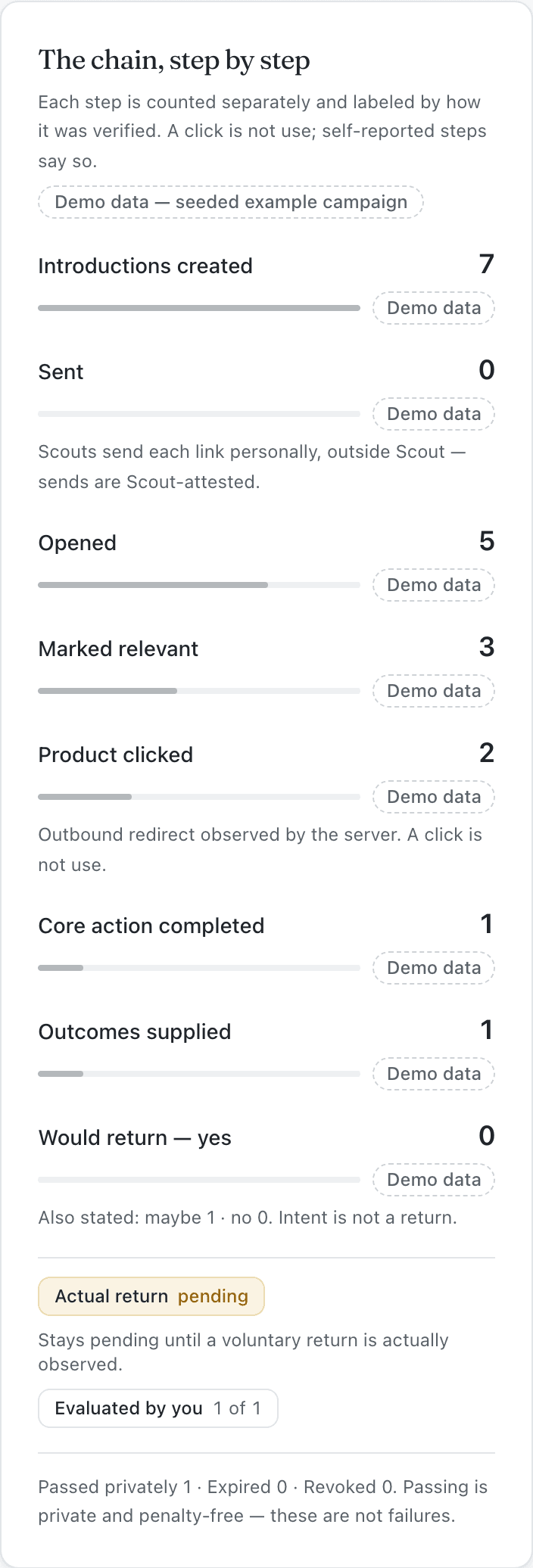
Scout keeps every rung of the chain separate, so the place people fall out of it is visible instead of averaged away. Each drop implicates something different.
01CreatedOpened
Look at the introduction itself: who the Scout thought of, and whether the moment you asked about was real for them.
02OpenedMarked relevant
Look at the brief's target and trigger. People opened it and decided it was not about them.
03Marked relevantProduct clicked
Look at your promise. The situation landed; what you offered to do about it did not pull hard enough.
04Product clickedCore action completed
Look at your first run. Relevant, motivated people arrived and something in the product stopped them.
A click is never counted as use, and an introduction is never counted as a customer. When a Scout initiated the introduction, Scout says so—this is a relevant introduction, not organic discovery, and reading it as anything else would cost you the diagnosis.
Reach
Relevant real people, reached the only way that survives contact.
Nobody is assigned to your campaign. Someone reads it, thinks of one specific person, and decides that person would genuinely want to know. That filter is the product.
One link, one intended person
Invitation links are single-use, private, revocable, and expire. There is no broadcasting and no contact import anywhere in the product.
Double opt-in, both directions
The Scout opts in by writing the introduction. The person opts in by choosing to engage. Either can stop without explaining themselves.
Disclosed and pressure-free
The person is told the Scout is not being paid, that they owe nothing, and what the commitment actually is—including your known limitations.
Their identity stays theirs
You receive only what the person permits: their outcome, their permissions, and whatever identity fields they chose to share. Never a contact list.
Pricing
Builders pay $99, once. Money never buys attention.
A Builder pays a flat $99 for 90 days of access, and that fee does real work: it funds the platform and filters out campaigns nobody should be asked to look at. It buys nothing beyond that, deliberately.
Builder access
$99
One payment. 90 days. Flat—not a subscription. Handled by Stripe inside the product; Scout never sees your card.
Sponsored access
Free
Your community operator can grant Builder access directly, at no cost to you. Ask them.
Scouts and the people they introduce
Free, always
Nobody on the receiving end of Scout is ever charged, or paid.
What access covers
- Platform access and campaign infrastructure.
- Campaign review, governance, and safety moderation.
- The introduction workflow and its consent record.
- Measurement with verification labels attached to every step.
- A filter that keeps unserious campaigns out of the community.
What money never buys
- A specific Scout.
- A number of introductions.
- Positive feedback.
- A better trust record.
- Preferential moderation.
- Guaranteed activation or conversion.
- Invitee identity or contact data.
Rated evidence
You rate the evidence, not whether you agree with it.
Every outcome you receive gets rated on three dimensions. Sentiment is not one of them, which is what makes critical feedback safe to give and worth reading.
Useful · Specific · Fair
Each rated 1–5. A 1 or a 2 requires a written explanation, and low ratings are checked for retaliation. You may reject a recommendation outright and still rate it specific and fair—that combination is normal and costs nothing.
Critical feedback earns full credit when it is useful, specific, and fair. Nothing in the product gives anyone an advantage for being positive about your product.
Then you say what you did about it
Each piece of evidence gets a recorded disposition, and shipped changes can be linked back to the evidence that caused them.
- Will change
- Already addressed
- Need more evidence
- Not changing, with reason
Eligibility
Not every campaign is worth someone's judgment.
Campaigns are reviewed before publication. The bar is not quality of idea—it is whether an honest answer is even possible.
What gets published
- A working product that delivers a meaningful action in a short session.
- A precise target person and the moment that triggers the need.
- One core action worth measuring.
- An outcome ladder that can be observed honestly.
- A trusted context where such a person plausibly exists.
What gets rejected
- “Test my app” and “tell me what you think.”
- Generic testing or review generation.
- A value horizon too long for a campaign to observe.
- Requests for bulk contact access or a guaranteed number of people.
- Anything relying on positive public reviews or endorsements.
- Actions that expose disproportionate private or sensitive data.
Getting started
From sign-in to a published campaign.
Membership is open and the path is short—here is every step between reading this page and a campaign in front of a Scout.
01Sign in with your email
Membership is open—sign in at /app and you're in immediately.
02Draft your campaign — free
The whole authoring flow is open: name the target person, the triggering moment, and the one action worth measuring. No payment to try it.
03Get Builder access to publish
$99, self-serve, inside the product. Or ask your community operator, who can sponsor it at no cost to you. Your draft waits either way.
04Every campaign is reviewed
Before any Scout sees it. Scout rejects campaigns that can't be evaluated honestly, not campaigns it merely dislikes.
Published campaigns are visible to signed-in members only, by design.
Start as a BuilderAttention cannot be bought. Scouts and Invitees are never paid. Nobody owes a test, review, signup, or positive response.
Ready to put it in front of someone real?
Start by reading a published campaign and the evidence attached to it.